A Long Division Calculator is a free online tool that divides any two numbers and instantly shows the quotient, remainder, and complete step by step solution. Enter your dividend and divisor, click Calculate, and get accurate results in seconds no signup required. Trusted by students, teachers, and parents worldwide for fast, reliable long division help.
Long Division Calculator
Modify values and click Calculate button
Result
Step-by-Step Solution
How to Use the Long Division Calculator
- Enter the Dividend Type the number you want to divide (e.g., 487)
- Enter the Divisor Type the number you are dividing by (e.g., 32)
- Click Calculate Hit the calculate button instantly
- View Your Results See the Quotient, Remainder, and full step-by-step solution
- Check Decimal Option Toggle to see result as decimal instead of remainder
What is Long Division?
Long division is a step-by-step mathematical method used to divide large numbers that are too complex to solve mentally. It breaks the division process into a repeating cycle of smaller, manageable calculations making it easier to find both the quotient and remainder accurately, even for very large dividends and divisors.
Long division is one of the four fundamental arithmetic operations, alongside addition, subtraction, and multiplication. It answers a simple question: how many times does one number fit into another?
Simple example: 8 ÷ 4 = 2 because 4 fits into 8 exactly 2 times.
When numbers do not divide evenly, long division finds either the exact remainder or continues to give a precise decimal answer both of which our calculator handles automatically.
Parts of Long Division
Every long division problem has four key parts. Understanding these terms is the first step to mastering long division and to reading the results our calculator provides correctly.
| Term | Definition |
| Dividend | The number being divided 487 |
| Divisor | The number dividing the dividend 32 |
| Quotient | The whole number result of division 15 |
| Remainder | The amount left over after division 7 |
Real-life example: Imagine you have 487 candies to distribute equally among 32 students. Each student receives 15 candies (the quotient), and 7 candies are left over (the remainder) not enough to give one more to each student
How to Do Long Division Complete Step by Step Method
Long division follows one simple repeating cycle remembered as DMSB Divide, Multiply, Subtract, Bring Down. Master this cycle and you can solve any long division problem, no matter how large the numbers.
The DMSB Cycle Explained
Every round of long division uses the same four actions in order
- Divide — How many times does the divisor go into the current number?
- Multiply — Multiply that answer by the divisor
- Subtract — Subtract the result from the current number
- Bring Down — Bring down the next digit from the dividend
Repeat this cycle until no digits remain.
Solved Example 1: 487 ÷ 32
Setup: Write 487 (dividend) inside the bracket. Write 32 (divisor) on the left.
STEP 1 — Look at First Digits
Take the first two digits: 48
Question: How many times does 32 go into 48?
- 32 × 1 = 32 (fits)
- 32 × 2 = 64 (too big)
→ Write 1 in the quotient above
STEP 2 — Multiply
1 × 32 = 32
Write 32 below 48
STEP 3 — Subtract
48 − 32 = 16
STEP 4 — Bring Down
Bring down next digit (7) → New working number = 167
STEP 5 — Divide Again
Question: How many times does 32 go into 167?
- 32 × 5 = 160 (fits)
- 32 × 6 = 192 (too big) → Write 5 in the quotient
STEP 6 — Multiply & Subtract
5 × 32 = 160
167 − 160 = 7
STEP 7 — Check for More Digits
No more digits to bring down.
7 is less than 32, so 7 is our final REMAINDER.
FINAL ANSWER: 487 ÷ 32 = 15 remainder 7 (written as 15 R7)
VERIFICATION CHECK (Always do this!):
(Quotient × Divisor) + Remainder = Dividend
(15 × 32) + 7 = 480 + 7 = 487 Correct!
Long Division with Fun Explanation!
PROBLEM: 487 ÷ 32

STEP 1: SETUP THE PROBLEM
We’re dividing 487 (dividend) by 32 (divisor).
Think of it like: “How many times does 32 fit into 487?”
STEP 2: DIVIDE THE FIRST DIGITS
Look at the first two digits of 487: “48”
Question: How many times does 32 go into 48?
32 × 1 = 32
32 × 2 = 64 (Too big!)
So, 32 goes into 48 → 1 time

STEP 3: MULTIPLY & SUBTRACT
Multiply: 1 × 32 = 32.
Write 32 under 48, then subtract.

48 – 32 = 16
STEP 4: BRING DOWN THE NEXT DIGIT
Bring down the next digit, 7.
Now the new number becomes 167.

Bring down the 7
STEP 5: REPEAT THE PROCESS
Question: How many times does 32 go into 167?
Check the multiples:
32 × 5 = 160 (Correct)
32 × 6 = 192 (Too large)
So, 32 goes into 167 5 times.
Write 5 in the quotient.

STEP 6: MULTIPLY & SUBTRACT AGAIN
Multiply: 5 × 32 = 160.
Write 160 under 167 and subtract.
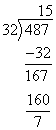
7 ← Remainder
167 – 160 = 7
STEP 7: FINAL ANSWER
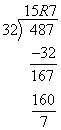
FINAL ANSWER: 15 remainder 7
VISUAL CHECK WITH A REAL-LIFE EXAMPLE
Imagine you have 487 candies and want to distribute them equally into 32 gift boxes. Each gift box receives 15 candies.
After filling all the boxes, 7 candies remain, which are not enough to fill another box.
So, the final result is 15 candies per box with 7 candies left over.
Long Division With Decimal How It Works
When the remainder is not zero, you have two options:
Option 1 Keep the Remainder: Write the answer as “15 R7”
Option 2 Continue to Decimal: Add a decimal point and keep dividing
To get a decimal answer, place a decimal point after the quotient, then add a zero next to your remainder and continue the DMSB cycle.
Example: 487 ÷ 32 continued beyond the remainder:
167 remaining → add decimal point → continue dividing Final decimal answer: 487 ÷ 32 = 15.21875
Our Long Division Calculator automatically shows BOTH forms remainder and decimal for every calculation. No extra steps needed.
Common Mistake to Avoid Using Long Division Calculator
| Common Mistake | What to Do Instead |
| Forgetting to bring down the next digit | Always bring down after every subtraction step |
| Choosing the wrong quotient digit | Use multiplication to test: too big or too small? |
| Subtraction errors mid-process | Double-check each subtraction before moving on |
| Stopping too early with digits remaining | Check: are there more digits left to bring down? |
| Not verifying the final answer | Always check: (Quotient × Divisor) + Remainder = Dividend |
Using of Long Division Calculator in Real Life
Long division is not just a school exercise it appears in everyday situations
Money & Finance: Splitting a bill of $487 among 32 people equally each person pays $15.21 (using decimal long division).
Cooking & Recipes: Dividing ingredient quantities when scaling recipes up or down for different group sizes.
Construction & Measurement: Calculating how many tiles, bricks, or planks fit into
a given space with materials left over.
Scheduling & Time: Finding how many full weeks fit into 100 days — 100 ÷ 7 = 14
weeks, 2 days remaining.
Computer Science: Remainder calculations (modulo) are fundamental in programming, cryptography, and data structures.
Understanding long division builds the foundation for algebra, fractions,
percentages, and advanced mathematics.
Why Use our long Division Calculator
| Feature | Our Calculator |
| Step-by-step solution | ✓ |
| Visual GIF examples | ✓ |
| Decimal result | ✓ |
| Remainder result | ✓ |
| Multiple solved examples | ✓ |
| Common mistakes guide | ✓ |
| Real-world examples | ✓ |
| FAQ section | ✓ |
| Verification method shown | ✓ |
| 100% Free | ✓ |
| No signup required | ✓ |
Frequently Asked Questions — Long Division Calculator
What is a long division calculator?
A long division calculator is a free online math tool that takes a dividend and divisor as input and returns the quotient, remainder, and a complete step-by-step
breakdown of the entire division process exactly as you would solve it by hand,
but instantly.
How does the long division calculator work?
Enter your dividend (the number being divided) and your divisor (the number
dividing it) into the input fields, then click Calculate. The calculator applies the standard DMSB algorithm Divide, Multiply, Subtract, Bring Down and
displays every step alongside the final quotient and remainder.
What is the difference between quotient and remainder?
The quotient is the whole number result of a division problem. The remainder is
the amount left over that could not be divided evenly. For example, in 487 ÷ 32:
the quotient is 15 (how many times 32 fits into 487) and the remainder is 7
(what is left over after 15 complete groups of 32).
Can this calculator do long division with decimals?
Yes. Our long division calculator shows both the remainder form (15 R7) and the
exact decimal form (15.21875) for every calculation. Simply toggle the decimal
option to see the result carried out to full decimal precision automatically.
How do I verify my long division answer?
Use the Golden Rule of division: multiply the quotient by the divisor, then add
the remainder. The result must equal your original dividend. Formula (Quotient × Divisor) + Remainder = Dividend.
Example: (15 × 32) + 7 = 480 + 7 = 487
What is a remainder in long division?
A remainder in long division is the number left over after the divisor has been subtracted as many times as possible from the dividend without producing a negative result. It is always smaller than the divisor. When the remainder is zero, the division is called exact or perfect division.
Is this long division calculator free?
Yes LongDivisionCalculator.net is 100% free. There is no account required,
no payment, no subscription, and no hidden charges. The calculator works on all devices including phones, tablets, and desktop computers.
Who can use this long division calculator?
This calculator is designed for students from Grade 3 upwards learning long division for the first time, as well as older students checking homework, teachers
preparing lessons, and parents helping children with math. The step-by-step format makes it a learning tool, not just an answer machine.
What is the DMSB method in long division?
DMSB stands for Divide, Multiply, Subtract, Bring Down the four-step cycle that makes up every round of long division. You divide the current number by the divisor, multiply to find the product, subtract to find the new remainder, and bring down the next digit to continue. This cycle repeats until all digits of the dividend have been processed.
What is the difference between long division and short division?
Short division is a simplified version used when the divisor is a single digit the working is done mentally and only the quotient is written down. Long division is used for larger divisors and writes out every step including multiplication and subtraction, making the process visible and easier to check. Our calculator uses the long division method and shows every step in full.
Whether you are solving a quick homework problem, teaching a class, or simply need to check your manual calculation, our free Long Division Calculator gives you instant, accurate results with every step shown clearly. Bookmark this page and return anytime no internet slowdowns, no loading delays, just fast and reliable long division solutions every time.
Calculate Now